







SerpApi
Junior Fullstack Engineer
Design, ship and support search APIs using Ruby, Rails, MongoDB and JavaScript in a remote-first, worldwide team.
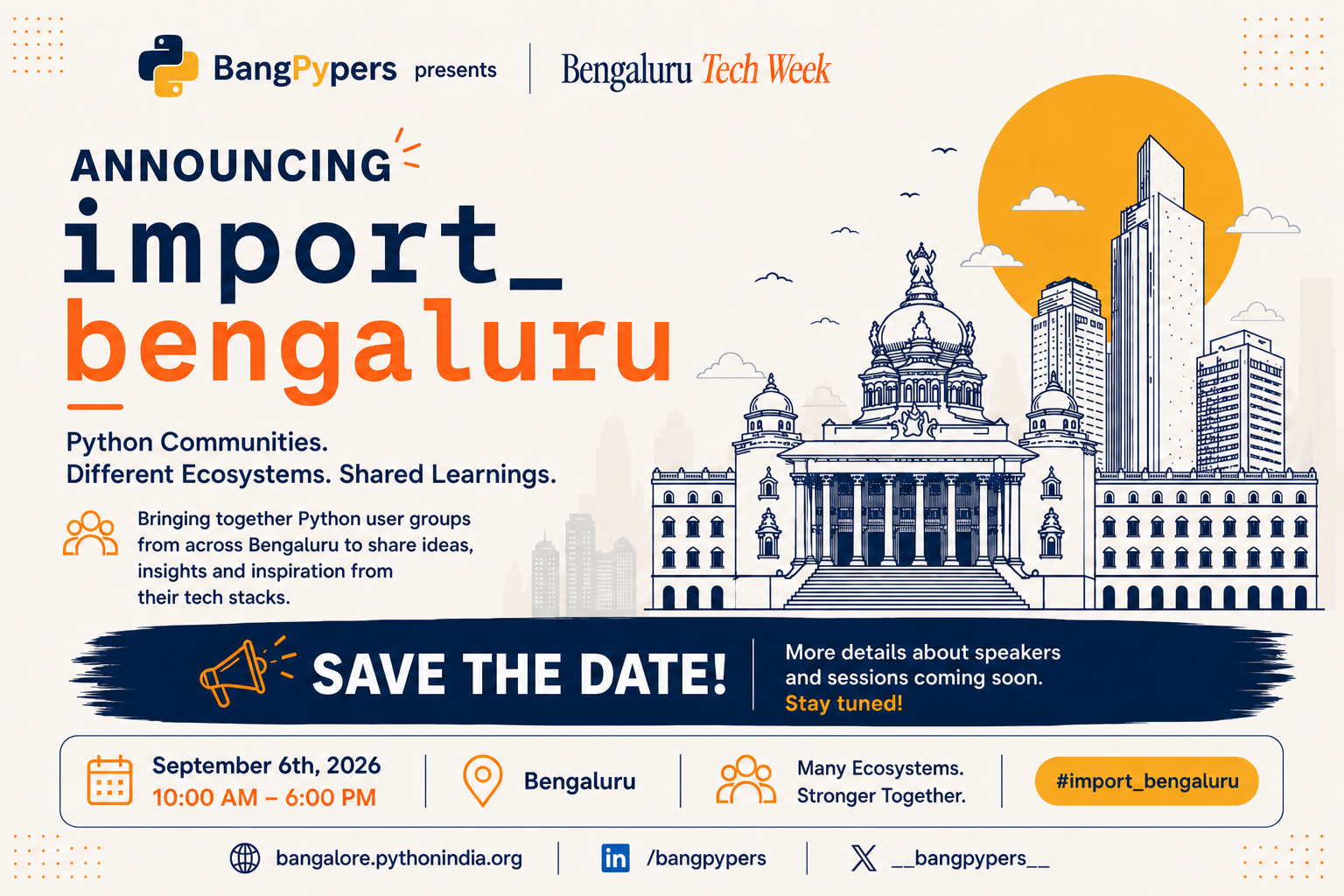
View role →BangPypers presents · Bengaluru Tech Week

Python isn't just one ecosystem. Meet the communities building Bengaluru's web, data, AI, scientific computing, developer tools and open-source infrastructure.
Venue Partner
We're excited to host the community at InMobi's Bengaluru office. Join developers, engineers, researchers and open-source enthusiasts for a day of learning, collaboration and community.

Why we're gathering
Across Bengaluru, Python communities often meet inside their own circles. import_ bengaluru brings those circles together for one day of practical talks, honest conversations and useful connections.
Community partners
Meet the groups shaping Python and open source in Bengaluru. More partners will be announced soon.
Bengaluru's Python user group, bringing developers together through meetups, workshops and open-source collaboration.
Visit community →
Data analysis and scientific computing across Python, R and Julia.
Visit community →
A student-run community building and contributing across open source.
Visit community →
Developers learning, collaborating and contributing across the Django ecosystem.
Visit community →
Apache Airflow's Bangalore Meetup group brings developers and data engineers together through meetups and open-source collaboration focused on Apache Airflow and the broader data orchestration ecosystem.
Visit community →
A community bringing together PyTorch users, researchers and machine learning practitioners across India to learn, collaborate and contribute to open-source AI.
Visit community →
A community for MongoDB users, developers and data practitioners to learn, share and connect.
Visit community →Agenda
Meet the speakers and explore what each session will cover.
Check in, meet the participating communities and settle in.
PyData Bangalore
Every AI framework, dataframe library and scientific tool in Python eventually bottoms out in NumPy, yet integer division is one of the most expensive things a CPU can do. Follow a multi-year contribution journey from replacing division by a constant with multiplication and shifts, through portable SIMD on Intel, AMD and ARM, to edge cases such as INT_MIN // -1. The session also covers a regression shipped to millions of users and what benchmarks, review and fixing it revealed about real open-source performance work.
Point Blank
Learn how Point Blank became what it is today, then see how Triton makes it possible to write fast, low-level GPU kernels in pure Python instead of dropping into C++ and CUDA.
SerpAPI
LLM knowledge alone is not enough for many real-world tasks. Using practical Python and SerpApi examples, this session shows how tools, MCP and reusable skills let agents search the web, retrieve current information and solve tasks beyond what an LLM can do on its own.
InMobi
Building the abstraction was the easy part. We designed an Offline Job Orchestration Platform—a thin layer over Airflow where a DAG declares intent (data, application and runtime) instead of hand-wiring paths, SparkConf and Kubernetes manifests—and it worked almost immediately. Then it sat there. More than 600 existing DAGs stayed where they were because migrating meant each team rewriting its own code on our schedule instead of theirs. Adoption is a cost problem, not a persuasion problem, so we stopped writing migration guides and shipped the migration itself. A transpiler built on Python's standard-library ast module rewrites legacy DAGs onto the new abstraction, while a triage classifier identifies which DAGs are automatable and which functions the tool should learn next. You'll learn to write your own codemod, what ast gives you for free, where it breaks and why the differ mattered more than the generator. Takeaways: every user step is an adoption tax; trust is the bottleneck, so ship the diff that proves nothing changed; and rejected DAGs are a design review of your abstraction. A platform nobody has migrated to is only a proposal.
Lunch and community connections.
PyTorch
Start with the core ideas behind PyTorch, then explore ExecuTorch and how PyTorch models move from development to efficient inference on mobile and edge devices.
Namma MUG
Build a retrieval-augmented generation application in Python and learn how MongoDB Vector Search stores embeddings, retrieves relevant context and grounds an LLM's answers in your own data.
BangPypers
A demo-led build of a minimal AI agent harness from the ground up. Unpack the agent loop, tool calling, context management and memory, then combine them into a working harness that clarifies how tools such as Claude Code and Codex work.
Participant-led conversations and short community talks.
Wrap up the day, share takeaways and make final connections.
Job board
Open roles shared by participating companies.
SerpApi
Design, ship and support search APIs using Ruby, Rails, MongoDB and JavaScript in a remote-first, worldwide team.
View role →SerpApi
Connect SerpApi with developer communities through technical content, documentation, events and partnerships. Remote worldwide; Python and JavaScript required.
View role →EPAM
Design production-grade GenAI, RAG and agentic systems for enterprise clients. Bangalore and other India offices; 9–14 years of experience.
View role →EPAM
Build scalable data science applications and production ML solutions on Domino Data Lab. Bangalore and other India offices; 5–14 years of experience.
View role →EPAM
Build production GenAI applications, RAG architectures and multi-agent workflows. Bangalore and other India offices; 7–12 years of experience.
View role →EPAM
Lead development of scalable Python systems using PostgreSQL, MS SQL Server, React and GitHub Actions. Bangalore and other India offices; 7–12 years of experience.
View role →Gold Sponsor
Thank you to SerpApi for supporting import_ bengaluru and Bengaluru's Python community.
Visit SerpApi →
Silver Sponsor
Thank you to MongoDB for supporting import_ bengaluru and Bengaluru's Python community.
 Visit MongoDB →
September 6, 2026 · inMobi Techonology, Bengaluru
Join developers, maintainers, data practitioners, researchers and open-source contributors from across the city.
RSVP on Luma →